Atzaró Okavango camp wellness safari: where Ibiza calm meets delta silence
The Atzaró Okavango camp wellness safari sits in a private concession between the Moremi Game Reserve and Gomoti Plains, where the Okavango Delta fans into a maze of channels. Here the Mediterranean roots of Atzaró Group meet the African bush, and the result feels deliberately intimate rather than ostentatious. You arrive by helicopter from Maun, the blades fall silent, and the only sound is water moving through reeds.
This Okavango camp has just ten suites, each with a plunge pool facing a lagoon that mirrors the sky at night. The architecture leans into clean lines and pale woods, a Balearic language translated into Botswana tones with thatch, canvas and handwoven African textiles. It is a luxury property, but the luxury is in space, quiet and the way wildlife moves freely through camp rather than in marble or chandeliers.
Atzaró Okavango is operated in partnership with African Bush Camps, whose team brings deep delta safari expertise to the Atzaró aesthetic. Their stated aim is simple and clear: “Game drives, mokoro safaris, walking safaris, spa treatments, and helicopter flights.” That list sounds like a brochure, yet on the ground each activity is paced to the Okavango season and the water levels, not to a rigid timetable.
Couples booking a luxury safari here will notice how the camp design supports a slower, more reflective experience. Wide decks invite you to sit barefoot between game drives, watching elephants cross the water while the heat softens. The Atzaró Okavango camp wellness safari is not about ticking off the Big Five; it is about how the delta feels when the mokoro poler stops paddling and the whole of Africa seems to listen.
Details such as the ten-suite layout, private plunge pools and helicopter access are confirmed in Atzaró Okavango’s official launch material and African Bush Camps’ camp fact sheets, which also outline the wellness focus and intimate camp size. Prospective guests should always cross-check the latest camp brochure or fact sheet, as operators occasionally refine suite counts, facilities and access logistics between seasons.
Wellness spa in the wild: imported ritual, African setting
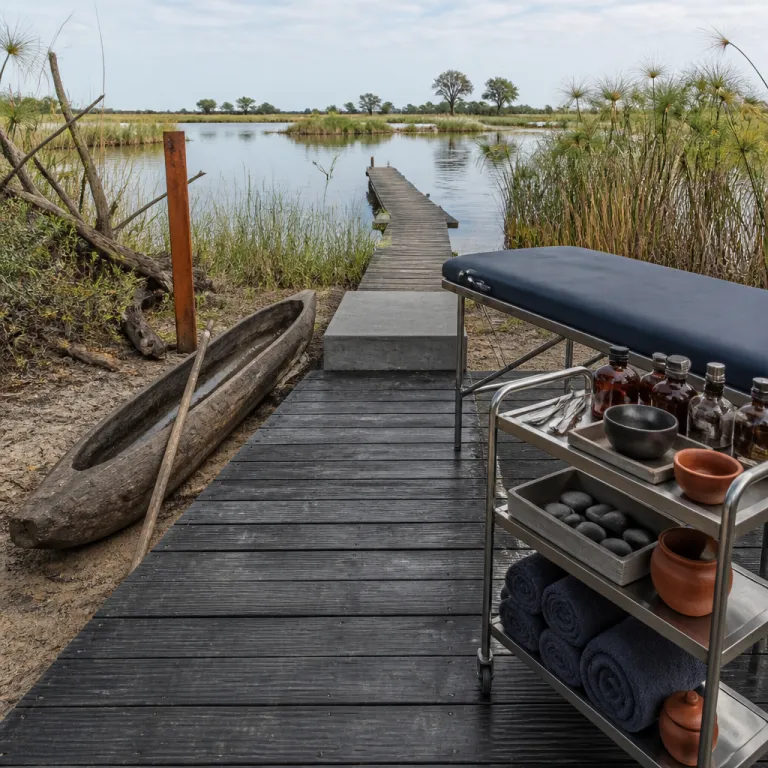
The wellness spa at Atzaró Okavango is unapologetically shaped by Ibiza, from the whitewashed treatment rooms to the scent of citrus oils drifting across the deck. You step from sand into a cool, shaded sanctuary, and the contrast between African bush and Mediterranean calm is intentional rather than accidental. For some guests this imported aesthetic will feel like a soothing anchor after long days of game viewing in remote Botswana.
There is a yoga shala open to the water, a state-of-the-art gym and a 20-metre main pool that frames the Okavango Delta like a cinematic backdrop. The 20 m figure is drawn from Atzaró Okavango’s launch communications and African Bush Camps’ descriptive material, which specify a long lap-style pool rather than a plunge pond. Therapists offer holistic treatments that borrow from European wellness philosophy but are delivered with a sensitivity to place, using natural textures and open-air salas that keep you connected to the sounds of wildlife. This is where the Atzaró Okavango camp wellness safari leans hardest into its Balearic DNA, and where the cultural tension becomes most visible.
Some purists argue that a wellness spa in a game reserve should be rooted entirely in local traditions, with treatments shaped by delta plants and indigenous knowledge. Others appreciate that Atzaró Group brings a consistent brand language from its Mediterranean properties, giving travelers a familiar wellness experience even as they navigate a very different corner of Africa. If you are weighing options, compare this approach with Xigera’s more delta-rooted spa philosophy, which feels sculpted from the Okavango itself rather than layered onto it.
For couples planning activities, the spa team will usually coordinate with guides so that massages follow morning game drives or walking safaris, not the other way around. That means you can track Moremi game on foot at first light, return to camp for a late breakfast, then move straight into a deep tissue treatment while the day heats up. A typical sample day might read: 05:30 wake-up, 06:00–09:30 game drive, 10:00 breakfast, 11:00–12:00 yoga, 13:00 lunch, 15:30–18:30 afternoon activity, 19:30 dinner and an evening spa slot on request. It is a rhythm that suits those who want both high-quality game viewing and serious wellness without feeling rushed between one and the other.
Behind the scenes, partnerships with local communities and conservation organisations help ensure that this style of luxury does not float above its surroundings. If you want to understand how villages shape safari economies in Botswana, read about the villages behind the concessions before you book. It adds context to every spa treatment taken while listening to distant drumming or cattle bells across the water.
Game drives, water levels and the reality of a delta safari
Any Atzaró Okavango camp wellness safari lives or dies by its time in the bush, and here African Bush Camps brings serious credentials. Twice-daily game drives head into the private concession between the Okavango Delta channels and the fringes of Moremi Game Reserve, where wildlife moves with the seasons rather than along park boundaries. You are not chasing sightings; you are reading tracks, water levels and wind direction with guides who know this terrain intimately.
During the dry season, when the flood has settled and the grass thins, game viewing can be exceptional, with predators working the edges of the water and plains game clustering on islands. In mid-season, as channels shift and some roads flood, the focus tilts towards delta safari experiences on water, with mokoro excursions gliding past papyrus and boat trips exploring deeper lagoons. The camp team will adjust each day’s activities to the conditions, so no two stays feel quite the same.
Walking safaris are offered when visibility and safety allow, giving you a slower, more sensory way to experience Africa. You notice the weight of hippo paths in the sand, the scent of wild sage, the way a breeze carries alarm calls across the floodplain. For many couples, these walks become the emotional centre of their luxury safari, more memorable than any lion sighting from a vehicle.
Helicopter flights are available at extra cost, and they change your understanding of the Okavango in a single sweep. From the air you see how the delta breathes, how water carves channels that dictate where wildlife will move and where camps can operate. Transfer and scenic flight durations of around 20 to 30 minutes between Maun and camp are quoted in African Bush Camps’ transfer guidelines, although exact times vary with routing and weather. It is also a reminder that every person-night in this ecosystem carries a conservation levy and a responsibility, not just a price tag.
When you compare Atzaró Okavango with other high-end properties in Botswana, look beyond headline rates and ask how each lodge invests that conservation levy. Some channel funds into landscape-scale initiatives, while others focus on scholarships, guiding programmes or direct support for nearby villages, and your booking effectively votes for one model over another.
Rates, single supplements and how to read the fine print
Luxury in the Okavango Delta comes with a price that reflects remoteness, helicopter logistics and strict conservation limits on bed numbers. At Atzaró Okavango, rates are typically quoted per person per night and include most activities, meals and local drinks, but you should always check the latest details with the camp or your agent. A conservation levy is usually added per person per night as well, supporting wildlife protection and community projects in Botswana. As a planning reference, many comparable luxury camps in the region quote levies in the range of roughly USD 20–30 per person per night, though exact figures for Atzaró Okavango are confirmed in current rate sheets.
Couples will want to pay attention to how single supplement policies are applied if one partner travels alone for part of the trip. Some seasons see reduced or waived single supplements, while in peak periods the supplement in USD can be significant for solo travelers occupying a double room. If you are combining this camp with other lodges in Africa, align your dates to minimise those extra costs across the itinerary.
Families considering the property can request a family suite, which offers more space and flexible bedding while keeping everyone close to the main areas. The Atzaró Okavango camp wellness safari is primarily designed for couples and small groups, yet the family suite option means multi-generational trips are still possible without compromising the camp’s quiet atmosphere. Always confirm age limits for walking safaris and mokoro outings, as safety rules are strict and vary by activity.
When comparing Atzaró Okavango with other luxury safari options in the Okavango Delta, look at what is genuinely included rather than headline rates alone. Some lodges bundle helicopter transfers, while others treat them as a separate supplement in USD, and that difference adds up quickly over several nights. Ask whether spa treatments are extra, how many game drives are guaranteed per day and whether private vehicles can be arranged at additional cost.
For couples planning a longer journey through Botswana, it can be smart to mix ultra-luxury camps like this with slightly more understated properties in other regions. That approach balances budget, reduces overall single supplement exposure and gives you a broader sense of Africa beyond one concession. A useful planning companion is this guide to romantic luxury hotels for couples in Botswana, which maps out how different camps and lodges fit together across the country.
Yoga, night skies and the rhythm of a wellness safari day
A typical day on an Atzaró Okavango camp wellness safari starts before sunrise, when a soft knock on the canvas signals coffee and the first game drive. You head out as the delta mist lifts, watching wildlife emerge into the light while the air is still cool and the bush feels freshly washed. Returning to camp, breakfast is served on the deck, and the rest of the morning opens into a blend of wellness and rest.
Late-morning yoga sessions take place in the open-air shala, with views across the Okavango water and the soundtrack of birds rather than playlists. This is where the European wellness aesthetic feels most at ease in Africa, because the practice is simple and the setting does most of the work. Couples who already weave yoga into daily life will find the transition from home studio to delta platform surprisingly natural.
Afternoons are usually reserved for a second round of activities, whether that means game drives, mokoro outings or walking safaris, depending on the season. As the sun drops, you stop for sundowners, watching colours bleed across the sky while hippos surface and the first night calls begin. Back in camp, the plunge pool still holds the day’s warmth, and a quick swim before dinner becomes a quiet ritual.
After dinner, many guests choose to sit around the firepit, letting the night deepen while guides share stories about the Okavango Delta and its shifting water levels. The sky here feels impossibly wide, and stargazing becomes its own form of wellness, a reminder of scale that no spa treatment can replicate. On some nights, short drives out of camp offer a taste of nocturnal game, but the real luxury is often the silence between sounds.
For couples weighing whether the Balearic-meets-African blend of Atzaró Group is right for them, the answer lies in how they want to feel rather than what they want to tick off. If you are drawn to clean-lined design, structured wellness programmes and the idea of a camp that feels like a Mediterranean retreat dropped into Botswana, this will resonate deeply. If you prefer a more traditional delta aesthetic, you might pair a stay here with a night or two at a more classically styled Okavango camp to experience both sides of Africa’s luxury spectrum.
FAQ
How do guests access Atzaró Okavango Camp ?
Guests reach Atzaró Okavango Camp via helicopter transfers from Maun International Airport, arranged through the camp or a trusted safari operator. The flight typically takes around 20 to 30 minutes, depending on routing and weather conditions, as outlined in African Bush Camps’ transfer guidelines and supporting rate documentation. Luggage is usually restricted to soft bags with strict weight limits, so plan your packing accordingly.
What activities are offered during an Atzaró Okavango camp wellness safari ?
Guests can expect twice-daily game drives, mokoro excursions when water levels allow and guided walking safaris in suitable conditions. The camp also offers spa treatments, yoga sessions, gym access and optional helicopter flights over the Okavango Delta at extra cost. All activities are scheduled around wildlife patterns and the season, rather than fixed clock times.
Is Atzaró Okavango suitable for families or mainly for couples ?
The camp is designed with couples and small groups in mind, focusing on quiet luxury and wellness. However, a family suite is available, and certain activities can be tailored for older children, subject to age and safety guidelines. Families should confirm minimum ages for walking safaris and mokoro trips before booking.
When is the best season to visit the Okavango Delta for this camp ?
The dry months usually offer the most reliable game viewing, with thinner vegetation and concentrated wildlife around water sources. In mid-season, rising or shifting water levels create excellent conditions for water-based activities like mokoro and boat safaris. Shoulder periods can be rewarding for photographers, with dramatic skies and fewer vehicles in the concession.
How does Atzaró Okavango balance luxury with sustainability ?
The camp uses solar power, limits guest numbers to ten suites and operates within a private concession that supports conservation through levies and fees. Partnerships with local communities and conservation organisations help ensure that tourism revenue contributes to long-term wildlife protection and livelihoods. Guests support this model through nightly conservation levies and by choosing operators committed to low-impact, high-value safaris.